
Following the Kurdistan Region of Iraq (KRI) Parliament session held on November 4, 2026, Patriotic Union of Kurdistan (PUK) leader Bafel Talabani announced on November 5 that his party was withdrawing from the regional government. Acting alongside the opposition New Generation Movement, Talabani declared that they would not recognize the parliamentary session—convened after a hiatus of nearly two years—nor any decisions, government, or appointed offices emerging from it, and that, depending on the circumstances, the PUK would establish a separate administration.
This statement and split brought back memories of the KDP–PUK civil war fought between 1994 and 1998, which cost the lives of approximately 5,000 Kurds, and brought scenarios of a “two-administration governance” (one centered in Erbil under Barzani control, the other centered in Sulaymaniyah under Talabani control) back onto the agenda.
To understand the scale of this tension between the KDP and the PUK and to forecast where it is heading, it is necessary to lay out the historical rivalry and the causes of disagreement between them.
The Recent 2024 and 2025 Elections
Six years after the Kurdistan Region parliamentary elections held on September 30, 2018, elections for the 100-seat parliament were held in October 2024. Winning 39 seats in the election, the Barzani family’s Kurdistan Democratic Party (KDP) came in first, while the Talabanis’ Patriotic Union of Kurdistan (PUK) placed second with 23 seats.
The seat distribution of the other parties represented in parliament was as follows: New Generation Movement (Nifşî Nû) 15, Kurdistan Islamic Union (KIU / Yekgirtu) 7, National Stance Movement (Halwest) 4, Kurdistan Justice Group (Komel) 3, People’s Front (Beray Gel) 2, and Gorran Movement 1.
In addition to these, minorities were represented through special quotas: 2 seats for Turkmens, 2 for Christians, and 1 for Armenians.
Emerging first from the elections, the KDP argued that the equal or 50–50 power-sharing arrangement of previous governments was no longer valid and that the distribution of ministries had to be based on election results. The PUK objected, claiming that winning more seats could not eliminate its status as an equal partner. The failure to resolve the dispute and form a new government led to the previous government, led by KDP Prime Minister Masrour Barzani, remaining in office.
In the Iraqi general elections held on November 11, 2025, the KDP received approximately 1.1 million votes nationwide and won 27 parliamentary seats, while the PUK received 574,000 votes and secured 18 seats. Winning twice as many votes as the PUK reinforced the KDP’s determination not to share governance equally.
The History of 50–50 Power-Sharing Between the Two Parties
The main cause of the latest crisis erupting between Masrour Barzani and Bafel Talabani is the disagreement over the equal sharing of power.
The first agreement between the KDP and the PUK based on 50–50 power-sharing was made in 1992. In the first parliamentary election held in the Kurdistan Region in May 1992, the KDP and PUK achieved near-equal representation with 50.8% and 49.2% of the vote, respectively. Ministries and administrative offices were divided equally between the two parties. However, disagreements between the sides escalated in 1994 into armed clashes—referred to in Kurdish political history as Birakûjî (fratricide)—and subsequently into a civil war. When Massoud Barzani requested military assistance from Saddam Hussein’s regime, the Iraqi army entered Erbil alongside the KDP and drove PUK forces out of the city. During this war, regional powers took sides: Iran supported the PUK, while Türkiye supported the KDP.
With the Washington Agreement signed in 1998 through U.S. mediation, an official ceasefire was achieved between the parties, and a geographically “two-administration” structure (one in Erbil under KDP control, the other in Sulaymaniyah under PUK control) emerged in northern Iraq.
The second agreement regarding the equal sharing of administration between the two parties was made in 2006. On January 21, 2006, Massoud Barzani and Jalal Talabani signed the “Kurdistan Regional Government Unification Agreement,” accepting that power, the cabinet, and administrative mechanisms would be shared equally (under a 50/50 formula). According to the agreement, the Regional Presidency and Prime Ministry were given to the KDP, the Vice Presidency of the Region was left to the PUK, ministries were divided between the two parties, and it was decided to unify the Ministries of Interior, Finance, Justice, and Peshmerga. The formation of the unified government was announced by Nechirvan Barzani on May 7, 2006.
To protect Kurdish constitutional gains in Baghdad, a separate “Strategic Cooperation and Alliance Agreement” was also signed between the two parties on June 27, 2007. This agreement was a political partnership established to defend Kurdish rights against the federal government.
The Cracking of the Alliance: The 2017 Referendum and Subsequent Fractures
The joint governance model established in 2006 never completely eliminated the separate political, economic, and military power centers of the two parties. By 2016, the eight-year strategic alliance had de facto come to an end.
Refusing to support the independence referendum held on September 25, 2017, under the leadership of Massoud Barzani, the PUK administration acted in parallel with Baghdad, Washington, Tehran, and Ankara, all of which opposed the referendum. This positioning deepened the rift between the two parties. On October 16, 2017, when the Iraqi army and Hashd al-Shaabi forces launched a sudden operation into Kirkuk and other disputed territories (along the Diyala, Saladin, and Nineveh lines) to retake them from the Peshmerga, the withdrawal of certain Peshmerga units affiliated with the PUK pushed the crisis of trust between the two parties to peak levels. Under domestic and foreign pressure following the heavy military and economic losses caused by the referendum, Massoud Barzani stepped down as President of the KRI in November 2017, though he continued to lead the KDP.
In the Kurdistan Region parliamentary elections held on September 30, 2018, the KDP won 45 seats and the PUK won 21. Since neither reached the absolute majority of 56 seats, the two parties once again sought an agreement: on March 4, 2019, a new political agreement was signed between the KDP and the PUK. Based on this four-year, 18-article political cooperation agreement, the KDP and PUK formed a coalition: Nechirvan Barzani was elected President of the Kurdistan Region in May 2019, and Masrour Barzani became Prime Minister in the vote held in June.
Despite this agreement, rivalry and friction between the two parties continued. On August 11, 2020, the two parties met again and reached an understanding to implement the 2019 agreement and lower tensions. However, this consensus failed to produce lasting institutional unification.
Parliamentary elections were supposed to be held again in 2022, but due to disagreements between the KDP and PUK, elections could not be held for six years, until October 20, 2024. The results of that election turned out as detailed at the beginning of this article. Because a new government could not be formed, the 9th cabinet—which received a vote of confidence on July 10, 2019, following the 2018 elections—still remains in office.
Fundamental Disputes Between the KDP and the PUK
In Iraqi Kurdish politics, language, geography, historical tribal relations, the sharing of economic resources, and differing political traditions have been decisive factors. In the geographical, political, and administrative division of northern Iraq, the regions where the Kurmanji and Sorani dialects are spoken also overlap with the spheres of influence of the two parties. Sorani is widely spoken in PUK-dominated areas such as Sulaymaniyah, Halabja, Ranya, and Kalar, while Kurmanji is predominantly spoken in KDP-administered areas such as Duhok and Zakho; in the capital, Erbil, Sorani is widely spoken. The areas governed by the KDP encompassing the Kurmanji geography are referred to as the “Yellow Zone,” while the Sorani geography governed by the PUK is known as the “Green Zone.”
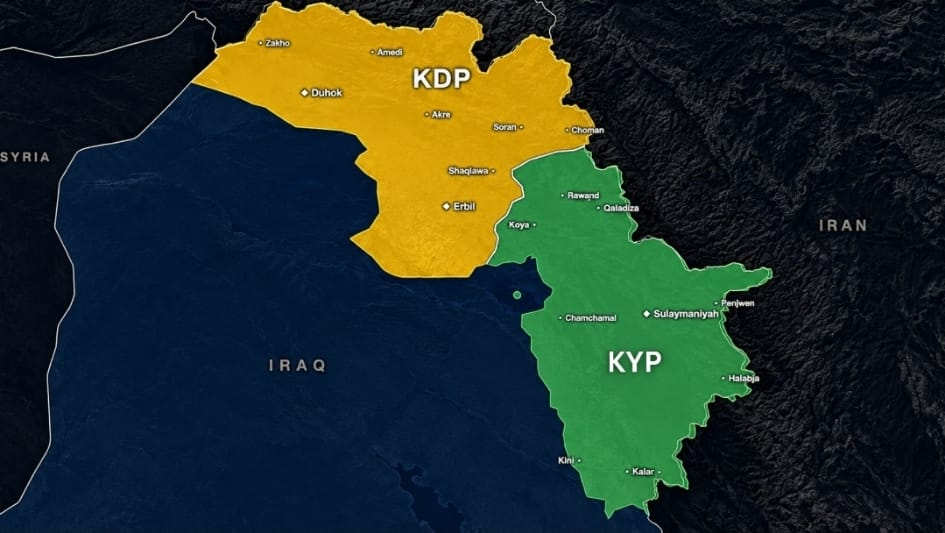
At the root of the conflict between the two parties—alongside the rivalry between their two leaders—was the question of who would control the revenues, territories, border crossings, and political institutions of the Kurdish autonomous administration that emerged de facto after the 1991 Gulf War. Similar demands lie behind the tensions experienced today.
A fierce rivalry persists between the Barzani-led KDP, centered in Erbil and Duhok, and the Talabani family’s PUK, strong in Sulaymaniyah, over having a decisive say in the governance of the Kurdistan Region. The allocation of the prime ministry, the presidency, ministries, and senior bureaucratic posts is a constant subject of dispute. The sharing of economic resources is another major point of contention between the two parties. These include the management of oil revenues, revenues from the Habur/Ibrahim Khalil Border Crossing, customs duties and commercial taxes, the respective shares of Erbil and Sulaymaniyah from the budget, and the disbursement of public employees’ salaries. The PUK accuses the KDP of failing to transfer budget shares received from the central government and oil revenues transparently and fairly.
Another major dispute concerns which party the President of Iraq should be selected from. Although not stipulated in the Constitution adopted by referendum on October 15, 2005, selecting the President of Iraq from among the Kurds has become a political convention. Following the election of PUK leader Jalal Talabani in 2005 and subsequently Fuad Masum from the same party, selecting the president from the PUK continued as a political tradition. Prior to the presidential election held on October 2, 2018, the KDP challenged this tradition by fielding its own candidate, turning the presidency into an outright political clash between the KDP and PUK. However, the PUK’s candidate, Barham Salih, won the election and became president. In the election held in 2022, the PUK’s Abdul Latif Rashid was likewise elected president.
Finally, in the Iraqi presidential election held in April 2026, the Talabani family nominated the PUK’s Nizar Amedi without consulting the Barzanis and secured his election as president. Having won the numerical majority of Kurdish votes, the KDP claims that Kurdish political representation in the country belongs to it; it accuses the Talabani camp of bypassing the KDP by conducting direct negotiations with the central government in Baghdad and criticizes this policy for weakening the Kurds’ weight within the federal structure.
The Reconvening of Parliament After Two Years and Political Fragmentation
On November 4, 2026, with the support of minority representatives, smaller parties, and MPs who had broken away from their parties—including three PUK members—the KDP secured the attendance of 52 MPs and succeeded in convening the KRI parliament, which had been paralyzed and unable to function for nearly two years. The PUK and the New Generation Movement boycotted the parliamentary session.
Characterizing the election of the parliamentary presidium during the session as “the unilateral breakdown of the power-sharing partnership” and “the imposition of the majority over the minority,” PUK leader Bafel Talabani announced his party’s complete withdrawal from the KRI caretaker government, which he deemed a failure. Stating that they would not recognize unilateral appointments and decisions centered in Erbil, Talabani issued a harsh warning: “If they appoint a President of the Kurdistan Region, we will also appoint a President of the Kurdistan Region. If they appoint a prime minister, we will also appoint a prime minister.”
The U.S. Withdrawal from Iraq Played a Role in the Process
The military mission of the U.S.-led international coalition in Iraq ended on September 30, 2026, and American troops withdrew completely from Iraq. KRI Prime Minister Masrour Barzani sharply criticized the U.S. decision to withdraw, stating, “It coincided with a turbulent period; we are left weak and vulnerable.” For the KDP administration, which had long acted with reliance on the U.S. regional presence and coalition support, the withdrawal of American troops—and particularly the removal of air defense systems and critical security infrastructure in Erbil—created a “security and deterrence vacuum.”
Seeing American protection weaken externally and regional risks increase, the KDP leadership acted with the reflex of “consolidating internal authority in a single hand without losing time,” convening the parliament that had not met for two years and moving to fortify its leadership in the KRI. To achieve this, Masrour Barzani risked escalating tensions with the PUK.
Could a Civil War Occur Between the Two Parties?
In a speech at a symposium organized by the Chatham House Institute in London, U.S. Ambassador to Türkiye and Special Presidential Envoy for Iraq Tom Barrack stated that the dispute between the two parties consisted of tribal quarrels, that the U.S. was tired of these disputes, that the U.S. would not intervene in this tension, and that they had to find a solution themselves.
Following the announcement that the U.S. would not get involved in the conflict between the KDP and PUK, the stance of the two major neighboring actors, Türkiye and Iran, along with the attitude of the Baghdad government, will shape whether the current crisis escalates into armed conflict.
The Stance of Regional Actors (Türkiye, Iran, and Baghdad)
Historically, Türkiye established a stability- and security-oriented partnership with the KDP, cooperated in the fight against the PKK, directed investments—primarily in energy—into the region, and built extensive commercial ties. Conversely, due to its close ties with the PKK, Ankara kept its distance from the PUK and even imposed sanctions on it. Over the past two years, however, a noticeable rapprochement has been observed between Türkiye and the PUK. The disarmament of the PKK under the “Terror-Free Türkiye – Terror-Free Region” policy lifted the organization’s pressure on the Talabanis. The appointment of a Turkmen governor to Kirkuk served as a strong gesture demonstrating improving relations. A pragmatic figure, Bafel Talabani takes care to develop relations with the U.S., Iran, and Türkiye alike, while also maintaining warm ties with the government in Baghdad.
Iran, for its part, has long maintained deep intelligence, political, and military ties with the PUK; both Tehran and the Shia-led administrations in Baghdad under its influence have supported the PUK against the KDP. They have viewed the fiercely competing dual-administration structure in northern Iraq as a strategic gain insofar as it weakens Kurdish unity and makes the region more dependent on the central government (and indirectly on Tehran’s sphere of influence).
Nevertheless, amid the chaotic environment resulting from the U.S./Israel–Iran war, neither Ankara nor Tehran wants instability and an uncontrolled internal conflict in northern Iraq right on their borders. Both states will likely issue stern warnings and exert pressure to prevent a new civil war between the KDP and the PUK.
Similarly, the Iraqi central government—whose economy has suffered $60 billion in losses due to the blockade of the Strait of Hormuz, which is seeking routes via Türkiye and Syria by shifting energy pipelines from the risky south to the north, and which views the realization of the Development Road Project as vital for its future—will also prefer to ensure stability in the north, prevent conflict, and act as a mediator.
Conclusion and the New Regional Equation
On September 10, 2026, the PUK-affiliated 70th and KDP-affiliated 80th military units were dissolved in order to depoliticize them and were transformed into a centralized military structure under the Ministry of Peshmerga, with an agreement to cooperate as a constitutional component of the Iraqi Defense System.
While expectations were that unifying the Peshmerga under a single command would eliminate partisanship within the forces and establish an institutional structure more harmonious with the central government, the sharp split between the two parties caused astonishment. Should a compromise fail to be reached, the risk has emerged that this unification will remain “on paper” and that there will be a return to party-affiliated militias.
The pain and devastation of the 1994–1998 KDP–PUK civil war remain fresh in the memory of the Kurdish public; there is strong societal backlash against the possibility of a recurrence of a war in which thousands of Kurds killed one another. Neither side’s leadership can muster the political courage to take on that responsibility. Should Bafel Talabani’s threat to break away from the KRI and establish an autonomous administration materialize, clashes are more likely to continue in the form of obstructing each other’s economic activities, harming mutual interests, and political boycotts.
Taking into account Bafel Talabani’s closeness to Baghdad, the question has arisen: “Does the PUK want to cooperate and strike a deal with Arab parties to abandon the federal structure, transition to a unitary system, and maximize its interests?” However, this is an unlikely scenario. Article 1 of the Iraqi Constitution establishes federalism as a fundamental principle, and specific articles governing constitutional amendments introduce very rigid provisions that legally block the abolition of the federal structure. Nor is there currently any political ground to achieve such a change. Nevertheless, the continuation of the crisis is far more likely to produce a picture resembling the functioning of a unitary state in practice, if not in law—that is, a structure in which the Kurdish region remains nominally autonomous while becoming subordinate to Baghdad’s central authority. Indeed, with its ruling in February 2022, the Iraqi Federal Supreme Court invalidated all oil contracts signed by Erbil and ordered the direct transfer of oil revenues to Baghdad; as a result, having suffered billions of dollars in revenue losses, the KRI has become financially entirely dependent on central budget transfers from Baghdad.
PKK leader Abdullah Öcalan’s declaration that demands for a separate nation-state, independence, federation, and autonomy have lost their validity and that a solution must be achieved through a “democratic integration” and “democratic society” model under the roof of a unitary republic; the disarmament of the PKK; the integration of the YPG into the official army in Syria; and the tension driven by tribal interests between the two major Kurdish parties in Iraq have all caused profound disillusionment among Kurds who harbor the ideal of an independent state, with every faction accusing the other of betrayal. PKK/YPG leaders in Syria and Iraq are expected to leave those countries and relocate to Europe.
Meanwhile, a new organizational concept based on “regional ownership”—in which neighboring states guarantee one another’s security—has emerged in the region and is visibly gaining strong acceptance. As a result, a new era has begun in which militia forces lay down their arms and official armies are recognized as the sole legitimate armed forces. A consensus of will has emerged across the Gulf, Mesopotamia, the Levant, and Anatolia regarding the sharing of resources for economic development and the joint securing of energy and supply lines, transforming into concrete projects through successive agreements.
The Mecca Joint Defense Agreement signed on August 7, 2026, among Saudi Arabia, Türkiye, and Pakistan has aroused great excitement and interest in the region. Many Muslim countries, including Iraq, are expected to join this alliance. Aiming to end armed conflicts in the region, ensure stability, and provide a collective response to external attacks, this alliance vision will reshape the internal order and foreign relations of Middle Eastern countries; in Iraq, by integrating marginalized Sunni Arabs into the system and rationalizing interest-based tribal administrations, it could enable the transformation of the ethnic- and sectarian-based state structure into a more inclusive model.
This article was published on sde.org.tr on November 12, 2026.