
We are passing through a critical turning point in global geopolitics where traditional alliances are dissolving and the unipolar world order is giving way to a multipolar structure. One of the most concrete reflections of this historical juncture was the strategic step taken by Algeria, one of North Africa’s strongest military actors, leaving behind the strict “internal defense” doctrine it had maintained for over half a century.
On October 26, the Algerian Parliament unanimously approved the “Memorandum of Understanding on Military and Security Cooperation Between the Government of the People’s Democratic Republic of Algeria and the Government of the Republic of Niger,” authorizing the deployment of troops to Niger to protect energy facilities.
A 50-year doctrine change: From passivity to proactivity
After gaining independence in 1962, Algeria sent its army (ANP) outside its borders for the first and last time during the 1973 Yom Kippur War against Israel. After this war, the deployment of the military outside national borders was constitutionally prohibited. The civil war in the 1990s led the army to focus entirely on protecting its own borders and ensuring internal stability. Concluding that remaining passive in the face of growing regional threats was impossible, Algeria radically changed its half-century-old defense doctrine through a constitutional amendment in November 2020. The President was granted the authority to dispatch the Algerian army across borders as an operational or peacekeeping force with the approval of a two-thirds majority in parliament.
Algeria’s steps toward becoming a regional power
The deployment of the Algerian army directly on Nigerien territory to protect the petrochemical and infrastructure facilities of the state energy company Sonatrach in Niger, approved by Parliament on October 25–26, 2026, is the first concrete application of this new doctrine. Thus, Algeria—possessing the second-largest army in Africa immediately behind Egypt—has transitioned from a passive actor defending its own territory to a proactive “regional power” capable of establishing a transborder security corridor along the Sahel and Mediterranean line. Spending approximately 8–8.8% of its GDP on defense is seen as the most concrete proof of Algeria’s claim to regional power status.
Niger, a member of the Alliance of Sahel States (AES) alongside Mali and Burkina Faso, began seeking new security partners after expelling French troops and Western bases from the country, intensifying military and economic cooperation with its northern neighbor, Algeria. While Niger’s defense expenditure for 2025 was around 400–450 million dollars, Algeria’s defense expenditure of 25.4 billion dollars reveals Niger’s need for Algerian protection.
Fearing that the instability and wave of terrorism in the Sahel might spill over into its own borders, and seeking to safeguard its economic investments and regional interests, Algeria has become a de facto partner of the Sahel Alliance.
The energy dimension of the cooperation
The Algerian national oil company Sonatrach is conducting oil exploration and extraction activities in the Kafra region of Niger. The primary goal of the mission to deploy troops to Niger is to ensure the security of Sonatrach’s oil projects and facilities, at the request of the Niamey administration.
However, this cooperation is not limited merely to protecting Sonatrach; it is directly connected to one of the most critical mega-projects in the region: the Trans-Saharan Gas Pipeline (TSGP). Starting from gas fields in southern Nigeria, the pipeline is planned to traverse Nigerien territory entirely before reaching Algeria. By connecting this pipeline to its existing infrastructure (Medgaz and Transmed), Algeria aims to transport Nigerian gas across the Mediterranean to Spain, Italy, and European markets. The pipeline is projected to carry approximately 30 billion cubic meters of natural gas annually.
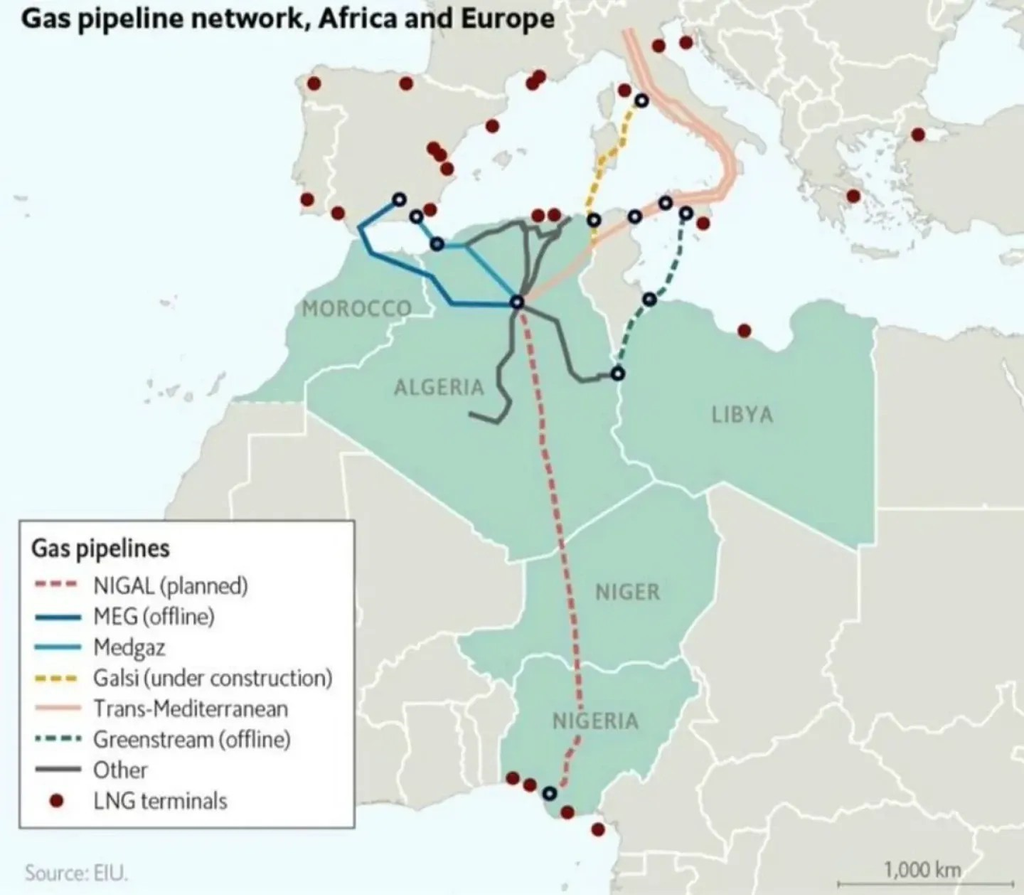
Radical elements affiliated with Al-Qaeda and ISIS, as well as smuggling groups, pose a severe threat in the Nigerien territory through which the pipeline will pass. Algeria’s military contribution to Niger aims to secure both border security and this energy corridor and infrastructure.
The Maghreb (North Africa) region is at the center of a deep geopolitical rivalry between Algeria and Morocco (particularly due to the Western Sahara issue). The defense cooperation memorandum signed with Niger provides Algeria with a significant advantage in this rivalry. Morocco wishes to advance the African-Atlantic Gas Pipeline project to transport Nigerian gas through its territory to Europe. However, Algeria’s project is shorter, cheaper, and faster to complete compared to Morocco’s coastal route. The weak point of the project is the security issue in the Sahel. By strengthening military cooperation with Niger, Algeria aims to mitigate these risks and gain geopolitical superiority over Morocco.
An alternative route for Niger’s uranium
Niger possesses some of the highest-grade uranium deposits in the world (accounting for approximately 4–5% of global production). Historically, a large portion of Europe’s—especially France’s—nuclear power plant uranium needs were supplied by Niger. Following the change in military leadership, the dominance of the French mining company Orano in the field was broken. While this created a gap in the West’s nuclear fuel supply chain, it paved the way for new actors in the Sahel.
For landlocked Niger, integrating uranium into the Mediterranean and global markets via Algeria opened the way for creating a “non-Western nuclear supply chain.” Algeria views supporting Niger militarily so that it can maintain its uranium sovereignty as part of its own national security; it aims to replace the French presence in the Sahel with its own regional leadership and become an indispensable transit actor in global nuclear and energy diplomacy. This is also seen as a reckoning for the millions of citizens Algeria lost in its war of independence against French colonialism.
Cooperation against separatist movements
The end of France’s military presence and the withdrawal of US forces created a vacuum that is now being filled by North Africa’s strongest local army, Algeria, rather than non-Western external actors—marking a historic turning point for the continent. This local umbrella, which prevents Niger from relying solely on external actors like Wagner/Africa Corps, gives rise to a regional security mechanism capable of reducing dependence on foreign mercenaries in Africa.
Rebellions and independence demands by the Tuaregs—who have large populations across Northern Mali, Northern Niger, and Southern Algeria—threaten Algeria’s territorial integrity. Through the military cooperation established with the Nigerien army, Algeria aims to protect its southern borders more strongly against separatism.
A new model for Africa
For 16 landlocked countries in Sub-Saharan Africa (Botswana, Burkina Faso, Burundi, Central African Republic, Chad, Ethiopia, Eswatini, Lesotho, Malawi, Mali, Niger, Rwanda, South Sudan, Uganda, Zambia, Zimbabwe), the Niger-Algeria partnership could become a successful prototype of a model (South-South cooperation) based on “relying on strong neighbors rather than global hegemons to reach ports and markets.” The transportation of Nigerien uranium and Nigerian-Nigerien gas through Algeria to the Mediterranean (Trans-Saharan Corridor) serves as the first large-scale intra-African example of technopolitical and logistical integration.
Conclusion
The Algeria-Niger military cooperation is notable in that Algeria has altered its historic defense doctrine to begin protecting its energy investments with its own military, placed the natural gas pipeline extending from Nigeria to the Mediterranean under a security umbrella, offered an alternative sales route for Nigerien uranium, established its own bloc against Morocco’s regional plans, developed a military alliance against Tuareg separatism, and created a model of relations for Sub-Saharan countries. This cooperation can be evaluated as the emergence of a new regional actor utilizing its military power as a foreign policy instrument, with the potential to directly influence the Eastern Mediterranean and Africa.
Algeria’s move in Niger is the practical manifestation of the “win-win partnerships” thesis gaining acceptance among nations.
In an era when the protective umbrella of traditional great powers has lost credibility, middle powers and regional forces constructing their own security architectures is becoming the main characteristic of the 21st-century multipolar world order. This strategic integration along the Algeria-Niger line clearly demonstrates both that Africa’s destiny is beginning to break free from the hands of foreign powers and that new-generation security pacts will be shaped around energy and logistics corridors.
In Algeria’s doctrine shift and especially its military rapprochement with the Sahel region, the strong influence of the Makkah Defense Alliance and its conceptual framework—which bases itself on “regional ownership”—is deeply felt.
Is there any specific section or terminology you would like adjusted or further clarified?
*This article was published on sde.org.tr on October 27, 2026.