
The invasion of Iraq—launched on March 20, 2003, by US-led coalition forces under the promise of “bringing freedom and democracy to its people”—came to an end at the close of this September with the complete withdrawal of American troops from the country. The military withdrawal of the US from Iraq also signified the end of the “Greater Persian Empire / Greater Iran” fantasy that Iran had once envisioned realizing through close cooperation with Washington.
Following the September 11 attacks, the 2001 Afghanistan and 2003 Iraq invasions conducted by the US and Coalition Forces were declared by then-US President George W. Bush as a “Crusade” to be carried out patiently, and Sunni Muslims in general were branded as terrorists that needed to be fought and eliminated. The Islamic Republic of Iran viewed this frenzy as a once-in-a-century opportunity. It used anti-terrorism cooperation with the US as a cover for Shiite expansionism across the suppressed Sunni geography, turning the conjuncture into an opportunity to establish a Greater Iranian State.
Within the framework of this expectation, the Islamic Republic of Iran became the greatest helper of the US in both the invasions of Afghanistan and Iraq. Former Iranian President Hashemi Rafsanjani, in a Friday sermon delivered in Tehran in 2002, admitted cooperation with America by stating: “The Americans should know that if it were not for the Iranian army, they would not have been able to topple the Taliban regime… Iranian forces killed the Taliban and facilitated its downfall. If our forces had not fought against the Taliban, the Americans would have drowned in the Afghan marsh.” Similarly, former Iranian President Ahmadinejad vented his frustration at the US in a television interview, saying: “We helped America in Afghanistan, and then we helped in Iraq. Despite this, Bush arrogantly accuses us of being an axis of evil.”
Former Iranian Vice President Mohammad Ali Abtahi also confirmed the aforementioned admissions of cooperation by Presidents Rafsanjani and Ahmadinejad during a speech on January 15, 2004, stating: “If it were not for Iran’s support, Kabul and Baghdad would not have fallen so easily.”
The US Handed Over the Occupied Iraq to Iran
Toppling the Saddam Hussein regime on April 9, 2003, the US established a federal state based on a quota system with the support of Shiites and Kurds. In this model, where Sunni Arabs—who constitute 30% of the population—were de facto excluded from governance, Shiite-majority administrations coming into power with US approval brought Iraq under Tehran’s control through sectarian affiliation. State administration, particularly the military, intelligence, and judiciary, fell into the hands of pro-Iranian factions. Shiite military militias established parallel to the official army were made part of the Axis of Resistance affiliated with the Iranian Islamic Revolutionary Guard Corps (IRGC). From 2016 onward, these militias transformed into power centers financed by the Iraqi state budget and serving Iran.
Millions of Iraqi civilians lost their lives—most of whom were Sunnis—both at the hands of coalition troops during the invasion and in the Shiite-Sunni civil war that erupted afterward. The US, which set out for a Crusade, effectively handed the country over from 2005 onward to Tehran—chasing a Greater Persian Empire—via politicians loyal to Velayat-e Faqih.
A 1,300-page report published by the US Army in 2019 evaluating US activities in Iraq between 2003 and 2018 clearly confirmed this outcome: “An emboldened and expansionist Iran appears to be the only victor (in Iraq) as this project completed in 2018.” The report’s emphasis was striking: “Iran and Syria provided space and support for Sunni and Shiite militants, while the US never developed a comprehensive strategy to stop it.”
Shiism Was a Tool for the “Greater Iran” Goal
Looking at the period since the revolution, it becomes evident that Shiism was used as a tool for the “Greater Iran” objective. In the imagination of the rulers of the Islamic Republic of Iran, the Persian Empire during the era of Darius the Great in the 5th century BCE was etched as an ultimate target (Kızılelma). The region referred to as the “Greater Iran” geography by Iranian politicians encompasses present-day Iran, Azerbaijan, Afghanistan, Turkmenistan, Tajikistan, Uzbekistan, parts of Pakistan, eastern Turkey, the Persian Gulf, Yemen, Iraq, and Syria.
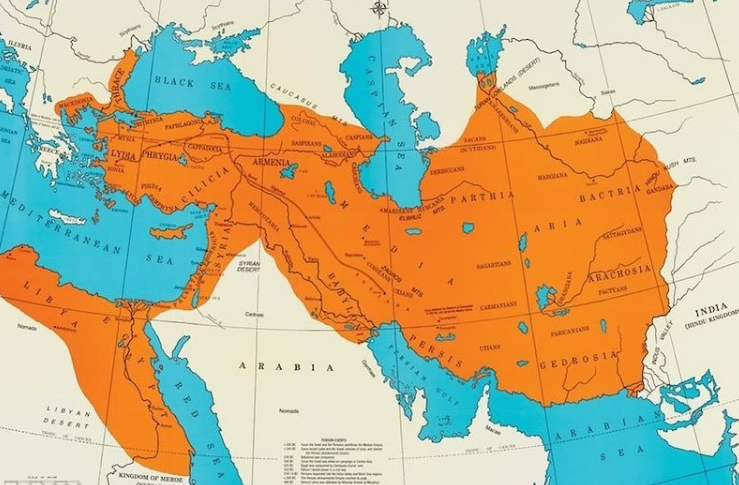
[Geography of the Greater Persian Empire]
The “Greater Iran” objective of the Persians was presented to non-Persian Shiites as the “Greater Shiite State.” Through sectarian affiliation, other communities were detached from their own kin and turned into servants of Tehran.
One of the most concrete expressions of this came from Aras Habib Karim, former Member of Parliament and Secretary-General of the Iraqi National Congress. Aras Habib, a Feyli Shiite Kurd tribal member and former intelligence officer, spoke on Samir Jawad’s program on Dijlah TV in September 2025. He stated that establishing a Greater Shiite State was a goal to which he dedicated his life, that he did not care who governed the country for this objective, that a project was made under Ahmed Chalabi’s leadership to reshape the Middle East map, and that with the help of the Americans and the Islamic Republic of Iran, the goal of establishing a Greater Shiite State across the geography from Afghanistan to Palestine had actually been realized, but people failed to understand it. He further accused Hamas of sabotaging the Greater Iran project, saying that the October 7 Al-Aqsa Flood destroyed the Shiite community and that their stupidity brought the region to this (bad) point, stretching from Iran to Yemen, Lebanon, and Syria.[i]
Aras Habib’s statement that the US helped establish a Greater Shiite State explicitly expresses the solidarity between the Shiite world and Washington, a partnership he feels no discomfort expressing.
Iran’s Cooperation on the Ground with the US and Russia
After the 1979 Revolution, the Islamic Revolutionary Guard Corps (IRGC), which saw itself tasked with spreading the revolutionary Islamic ideology to the entire world, sought to bind all Shiites across the globe to the religious authority of Velayat-e Faqih. Iran allocated significant resources and means to control Shiites in countries within the “Greater Iran” geography, assume the role of their protector, organize them as opposition political and armed forces in their home countries, use them as threats against their respective states when necessary, and transform them into a strategic power for itself. Iraq became the geography where this model—aiming to turn Shiite elements into armed instruments of Iranian policy—was implemented most effectively.
From 2005 onward, the US turned a blind eye to governments in Iraq being formed by pro-Iranian factions and to the military and state bureaucracy falling under the control of the same groups, creating an environment favorable for the expansion of Iran’s regional influence. The US invasion of Iraq enabled Iran to establish an uninterrupted corridor of influence extending to the Mediterranean, and Hezbollah’s logistical lines were directly connected to Iran through Iraq. Detached from the region, Iraq’s economy also came entirely under Iranian control.
Cooperating with the US against Sunnis in Iraq, Tehran did not hesitate to engage in similar cooperation with Russia in Syria. To suppress the popular demands for freedom that began in 2011, it entered into sectarian solidarity with the Shiite/Nusayri minority regime and bloodily crushed these demands alongside Russia.
The “fight against ISIS” campaign—which Donald Trump stated was created as a project by former President Barack Obama and Secretary of State Hillary Clinton—provided Iran and its armed militias with legitimacy and military maneuvering space. To protect the Assad regime, the IRGC Quds Force brought into Syria an estimated 150,000–200,000 foreign armed militiamen, including Lebanese Hezbollah (composed of Arab Shiites), the Fatemiyoun Brigade (Afghan Shiite Hazaras), and the Zainebiyoun Brigade (Pakistani Shiites). Hundreds of thousands of Syrians were tortured and massacred, and nearly half of the Syrian population was displaced. No one spoke up against this oppression on the grounds that they were “fighting against ISIS.” The anti-ISIS mission coordinated by Brett McGurk fortified the Iraq-Syria-Lebanon line in favor of Iran.
Iran also activated the Shiite/Zaydi Ansarallah organization to seize Yemen, where 70% of the population is Sunni/Shafi’i. Following the Houthis’ capture of the capital Sana’a, Tehran Deputy Alireza Zakani declared Iran’s regional objective in a September 2014 speech: “Sana’a is the 4th Arab capital to fall under Iranian control after Baghdad, Beirut, and Damascus,” adding, “The Yemeni revolution will not be limited to Yemen alone. Following its success, it will spread into Saudi territory. The wide border between Yemen and Saudi Arabia will help accelerate the revolution reaching deep into Saudi territory.”
Iran’s growing influence along the Iraq-Syria-Lebanon axis and in Yemen, alongside its unstoppable regional expansion, alarmed Arab monarchies that felt their rule threatened, prompting them—with US encouragement—toward cooperation with Israel.
The Middle East was tacitly carved up into spheres of influence between Iran, which sought to reach the Mediterranean coast with ambitions of establishing a New Persian Empire, and Israel, which aimed to take control of the region within the framework of the Promised Land (Eretz Yisrael) ideal.
The Al-Aqsa Flood That Broke the Status Quo
The aforementioned observations by Aras Habib Karim—accusing Hamas of sabotaging the Greater Iran project by stating that the October 7 Al-Aqsa Flood ruined the Shiite community and that their stupidity brought the region to this bad point from Iran to Yemen, Lebanon, and Syria—represent a critical assessment; it is an exposure of the hidden status quo between Iran and its armed militias and Israel.
In the Second Lebanon War that began on July 12, 2006, Israel failed against Hezbollah’s resistance and was forced to withdraw 34 days later from the Lebanese territory it attempted to occupy. After a ceasefire was established via UNSC Resolution 1701, no significant conflict occurred between the two sides for 17 years until October 7, 2023 (with the exception of a minor clash in the Shebaa Farms area in January 2015). Remaining faithful to the ceasefire with Israel, Hezbollah entered Syria from 2012 onward to support the Bashar al-Assad regime, fighting solely against the Syrian people and serving Iran’s dream of building a Persian Empire reaching the Mediterranean. This 17-year period was utilized by Israel, in accordance with its strategy termed “Campaign Between Wars” (MABAM), as a preparation period to crush Hezbollah whenever the status quo was broken. US and Israeli tension and conflict with Iran remained limited to the threat of destroying its enriched uranium production capability.
Following Hamas’s attack on October 7, 2023—dubbed the Al-Aqsa Flood—to break the blockade against Israel, the 17-year status quo collapsed. Prepared for this day, Mossad neutralized 6,000 to 7,000 Hezbollah operatives in two moves by detonating the “reliable” pagers and communication devices distributed to Hezbollah members by the IRGC. Its leadership structure was eliminated through targeted assassinations.
The Iranian administration distanced itself from Hamas by declaring that it had neither planned nor ordered the Al-Aqsa Flood attack. Not only did Iran refrain from directly entering the war against Israel, but it also strove to keep its militia forces in Syria, Lebanon, and Iraq out of the conflict. It did not immediately retaliate against Israel’s numerous lethal strikes targeting Axis of Resistance militias and the Revolutionary Guards commanding them, trying to preserve the status quo despite everything.
However, the tide had turned. The Netanyahu government, backed by Ultra-Orthodox factions, decided to act to claim the promised lands, which also encompassed Iran’s spheres of influence. With the realization that the status quo would no longer hold, the sectarian Shiite expansion that had been paved since 2005 came to an end.
US-Israeli Attacks on Iran
While conflicts between Iran and Israel prior to 2024 were conducted via covert operations and proxy forces, in 2024 the sides began launching direct strikes targeting each other’s territories or diplomatic missions. In retaliation for the attack on the Iranian Consulate in Damascus that killed IRGC generals, Iran launched True Promise I in April 2024. In response to the assassinations of Hamas leader Ismail Haniyeh in Tehran and Hezbollah leader Hassan Nasrallah in Beirut, Iran launched True Promise II in October 2024, firing ballistic missiles, cruise missiles, and drones at Israel.
This was followed by the 12-Day War (June 13–24, 2025), during which Israel conducted airstrikes on Iranian territory, and the ongoing war initiated by the US and Israel against Iran on February 28, 2026. Having lost its supreme leader, numerous high-ranking officers, and executive cadre in these attacks, Iran retaliated by striking US bases in Gulf countries as well as energy facilities and infrastructure in Arab nations. By closing the Strait of Hormuz, it plunged the world into an energy crisis. At this point, US President Donald Trump finds himself unable to determine how to conclude the war he launched under Israeli guidance.
Conclusion
Iran failed to receive the resistance and support it expected from the Axis of Resistance—which it had built since 1998 at a cost of at least $50 billion—when it came under attack. Hezbollah was easily neutralized through the Mossad operation. Insurgents led by Ahmed al-Sharaa captured Damascus in 14 days and toppled Bashar al-Assad, forcing imported Shiite militia units to retreat to Iran. Meanwhile, Iraq—which had known no peace or stability since the invasion—stepped out of Iranian control and moved toward establishing balanced relations based on mutual interests with regional countries. The new Iraqi government is determined to disarm the IRGC-affiliated Hashd al-Shaabi militias. The disarming of Hezbollah militias in Lebanon and their surrender of weapons to the state also appear imminent.
The arrogant Iranian regime, which harbored ambitions of dominating and dictating terms to Middle Eastern countries, faced new realities following the Al-Aqsa Flood. The ease with which its supreme leader, military commanders, and top executive tiers were targeted by Israel right in its own capital exposed the severe vulnerabilities it suffered from. With the collapse of the Axis of Resistance, Iran shifted from exporting revolution to struggling to defend its own borders. Even if the war comes to an end, the Tehran administration fears that street protests will reignite due to the deepening economic crisis, leading to a total loss of control.
Meanwhile, the countries in the region that once lived under its shadow of fear have begun coming together around the concept of regional ownership—forming alliances, uniting their strengths, and building a foundation for regional security and stability that requires no foreign hegemon.
Failing to find the support and resistance it anticipated from its armed proxy forces, Iran has now deployed its unarmed troll forces. Attempting to manipulate public opinion, it accuses Muslim states that chose not to aid it in its war with the US, as well as the newly established Mecca Defense Alliance, of American-Israeli collaboration.
The Iranian leadership wants the world to forget its efforts to resurrect the Greater Persian Empire with US leeway, its attempts to forcibly coerce regional states into it, and the ruthless killing of millions of innocents for this cause. However, forgetting these grievances will not be possible. Furthermore, defining the immense damage and losses Iran has suffered in this war—the loss of hundreds of statesmen, military officers, and intelligence personnel, and the deaths of thousands of innocent Iranians under tons of bombs after the US and Israel, its long-time behind-the-scenes partners, suddenly turned their weapons against it—is best understood as divine justice. After everything that has transpired over the last 30 years, it is impossible for the Islamic world to forget Iran’s dark past…
[i] https://x.com/RBursa/status/2095449114028732534
*This article was published on sde.org.tr on October 8, 2026.
.